The reserved placards on the chairs in the front row told me this was not an ordinary gathering.
At UN Women headquarters during United Nations General Assembly week, representatives from governments, international organizations, NGOs and the private sector came together to formalize the Hospitality Chapter of the Surging Women’s Employment Initiative, or SWEI, for the Middle East and North Africa.
SWEI is a UN Women initiative focused on expanding women’s access to employment through coordinated action among public-sector, private-sector and civil society partners.
The chapter has a clear ambition: to help connect 9,050 women in the Middle East and North Africa with employment opportunities in the hospitality sector by 2030. Diversey, a Solenis company, is supporting that work with UN Women through programs and partnerships that connect training, industry relationships and practical opportunities for paid work.
Through SWEI’s Hospitality Chapter, UN Women, Solenis and Diversey are working with partners to help expand employment pathways for women in the hospitality sector across the Middle East and North Africa.
My attention kept returning to the placards, each marking a seat for someone helping shape policy, investment and opportunity across entire regions.
Solenis had a seat at this table.
What I did not yet understand was that being there was only the beginning. The more important question was what we could contribute once we had a seat.
How partnership supports women’s employment
Earlier that day, our Solenis delegation gathered before the event to talk through what we hoped to contribute.
The group brought more than functional expertise. It brought a shared understanding of how sustainability, talent, inclusion, customer relationships and regional knowledge can come together to create practical opportunities through programs such as Linens For Life™ and Karama. Dr. Lotta Kanto Öqvist, Chief Sustainability Officer for Solenis, led the delegation and helped connect those perspectives to the opportunity in front of us.
My role was different. I was there to help carry the purpose and potential of this work beyond the room, so more people could understand why it matters.
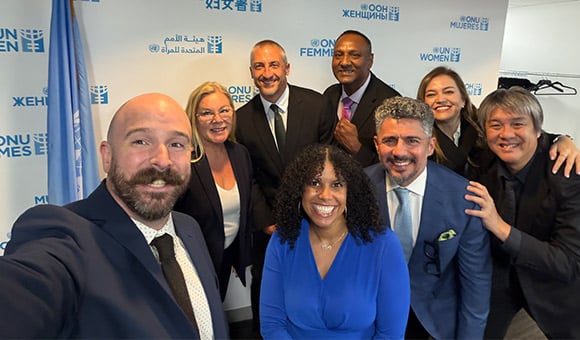
What united us was a belief that business can help create opportunity when relationships, experience and commitment come together. We talked about what the team had already learned through our Creating Shared Value programs and how that experience could help support something larger.
Turning ambition into hospitality career pathways
After the signing ceremony, the roundtable conversation turned to why practical action matters.
That conversation was grounded in a clear regional challenge: women remain significantly underrepresented in the labor market, especially in sectors where hiring networks, skills development and advancement pathways can determine who gets access to opportunity. Expanding access to decent employment and career advancement is not only an economic priority; it is also a practical way to strengthen families, communities and businesses.
The challenge is turning that economic and human imperative into practical opportunities for women
The Hospitality Chapter is designed to help do that by connecting partners that can support different parts of the employment pathway. Linens For Life™, Diversey’s Creating Shared Value program, transforms retired hotel textiles into new products made by women producer groups, helping create income opportunities while extending the useful life of materials. Karama, a digital hospitality training platform, complements that work by helping women build skills and earn certifications that can support employment in the sector. Together with UN Women, customers and local partners, these programs can help connect skills training with opportunities for paid work.
Where Influence Met Opportunity
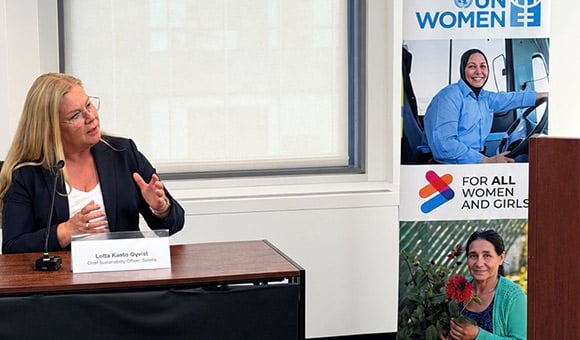
One moment I will not forget came from Lotta.
Before Lotta approached the microphone, I asked how she was feeling. Her answer stayed with me:
“I’m usually presenting to fellow colleagues within our industry,” she told me. “Today, I’m speaking to people who can change the world.”
Her words captured what many of us were feeling.
The room brought together leaders and decision-makers from sectors that do not always share the same space, united by the belief that expanding opportunity for women can benefit businesses, economies and society.
The signing ceremony formally recognized the partnership and the commitments behind it. But what resonated most with me was the sense that the real work begins after the signatures are added. Their value depends on the action they help make possible.
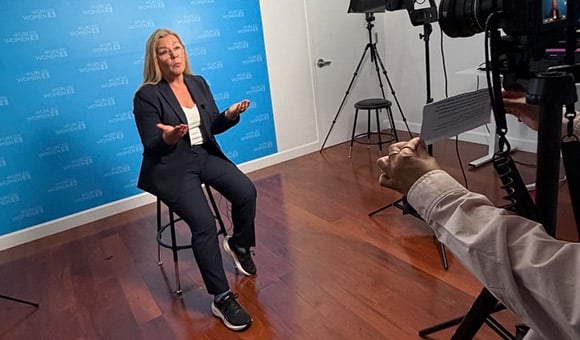
After the event, Lotta and I were escorted to a nearby studio, where she recorded an interview for a broader UN Women campaign. It was a reminder that this conversation would continue through new stories, relationships and efforts to support women’s employment across the region.
Connecting Solenis and Diversey programs to SWEI
During my trip home, I kept returning to a feeling that surprised me.
It was not pride.
It was responsibility.
As speaker after speaker discussed the challenge of creating meaningful employment opportunities for women at scale, I thought back to the conversations our team had before the event.
Then something clicked:
Wait a minute. We already do some of this.
Not through SWEI specifically, and not yet at the scale discussed in the room. But Solenis and Diversey have spent years learning how business relationships, local partnerships and practical problem-solving can support community-focused programs. Across our Creating Shared Value portfolio, we connect business capabilities with community needs and customer priorities to support livelihoods, education, resource stewardship and opportunities for underserved communities.
Why collaboration matters for women’s employment
That experience was one piece of a much larger puzzle. Solenis and Diversey can help connect UN Women with hotel operators, owners and suppliers across our hospitality customer base, extending the initiative’s reach into procurement and workforce decisions. Others bring policy expertise, local knowledge, community relationships and implementation experience. No single person, program or organization can solve a challenge this complex alone.
When partners contribute what they do best, shared ambition can become practical opportunity. I entered the room thinking the story was that Solenis had a seat at the table. By the end of the day, I understood that the more important story was what everyone around it could accomplish together.
Learn more about our Creating Shared Value programs.