Cooling towers rely on makeup water to replace any water lost via evaporation and blowdown, as shown in Figure 1 below. In most cases, makeup water comes from city supplies or wells, and the quantity and quality of the water can be easily measured using water meters and analytical equipment. Nevertheless, it is important to understand that not all makeup water and cooling tower blowdown sources are as simple as those depicted in Figure 1.
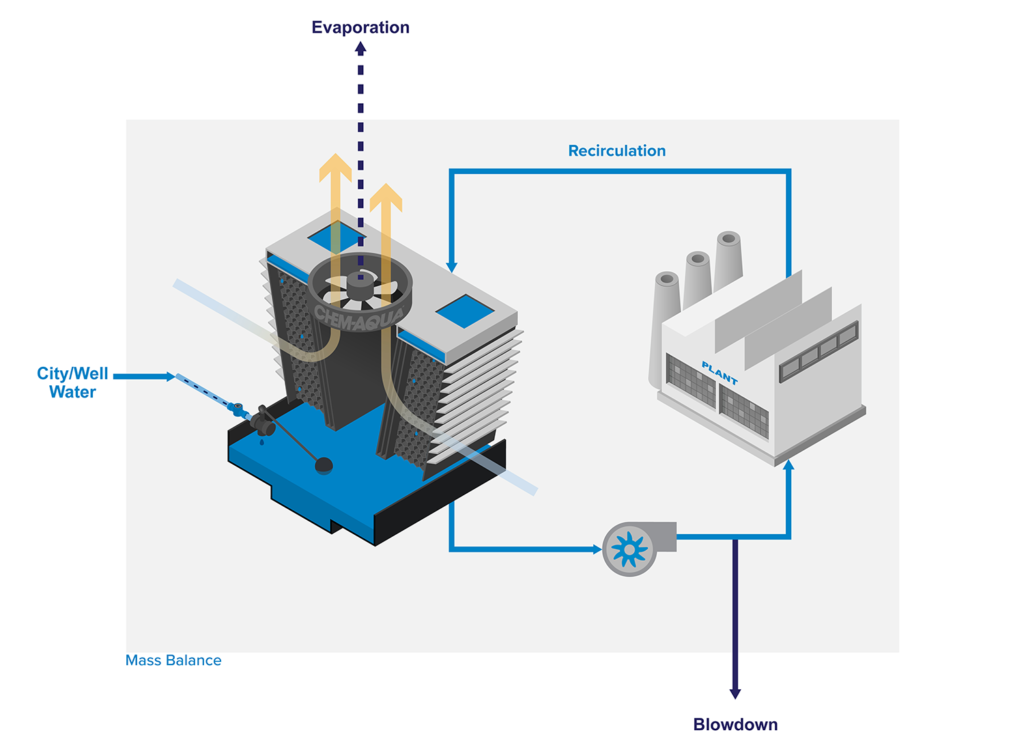
Makeup Water: Intended and Unintended Sources
The term ‘Makeup Water’ refers to any water that enters the system, intentionally or unintentionally, replacing the water that gets lost from the system.
- Intentional Makeup Water Sources: Intentional makeup water comes from planned sources such as city water supplies, well and treated recycled water (e.g., rain water, air-handling condensate, reclaim water). Typically, these sources are measured and tested. This ensures that they are predictable and easy to manage within a water treatment system.
- Unintentional Makeup Water Sources: A leaking heat exchanger may send processed water, fluids, or other harmful products into the system without warning.
Process water leaks can go unnoticed for a significant period of time if they are not monitored. Rain water can also enter open sumps providing unmetered makeup water. - The impact of Makeup Water on the system: Unintended makeup sources will reduce the demand for makeup from the intended source.
Understanding Blowdown in Cooling Towers
Blowdown is the removal of water from a cooling tower that has become concentrated with ions due to evaporation. It is a critical part of scale, corrosion, and even microbiological control.
- The Impact of Excessive Blowdown: Although blowdown plays an important part in the overall health of a cooling tower, too much blowdown significantly increases water and chemical usage, driving up costs. In addition, if the water is removed too quickly, biocides may not have enough time to work as effectively.
- Risks of Insufficient Blowdown: If the blowdown is insufficient, the saturation of ions can go beyond what the inhibitors can handle and cause scaling. Some biocides can over stabilize and become ineffective. Corrosion may increase as scaling and microbiological control are lost. Lower concentrations of hardness and alkalinity will naturally make the water more corrosive.
- Uncontrolled blowdown Sources: All blowdown is not necessarily controlled by design. Leaks, drift, overflow, and filter backwash are all forms of blowdown that cannot easily be measured or controlled.
As long as the uncontrolled water losses are less than the blowdown requirements, it does not impact the scaling tendency and programmed blowdown will still control overall water concentration. However, if the uncontrolled blowdown is greater than required, the water may become more corrosive due to lower buffering from lower concentrations of system ions. Chemical and makeup water requirements will increase and, in some cases, biocides will lose efficacy as they are not maintained in the system at a toxic dosage.
Successful Water Treatment Through Better Control
A successful water treatment program must account for both water losses and gains from chemical and control perspectives. Overlooking these factors can lead to inefficiencies and poor results.
Leveraging automation, data collection, and analysis is essential for identifying key variables and making precise adjustments to maintain system performance.