The Often Overlooked and Undervalued Boiler Protectors
Steam boilers do exactly as their name implies, they produce steam; however, many factors must be considered and managed to do this, including corrosion, scale, water minimization, fuel efficiency, safety, and Total Cost of Operation. Boiler feedwater often contains dissolved gases, such as oxygen, carbon dioxide, and ammonia. These dissolved gases are problematic for the boiler system because they may cause corrosion, leading to equipment failures (e.g., carbon dioxide can form carbonic acid in boiler condensate, lowering the pH, and corroding the condensate piping). To minimize corrosion, the dissolved gases must be removed or neutralized. This can be achieved through the use of deaerators, which work to remove such dissolved gases to low levels reducing the amount of follow-up neutralization required (e.g., sulfite-based oxygen scavenging).
What is Deaeration?
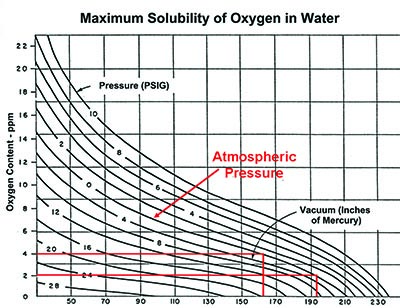
Undesirable dissolved gases, such as oxygen, carbon dioxide, and ammonia, have reduced solubility at higher temperatures (see Figure 1). Deaeration uses mechanical equipment to not only increase the temperature of the water but to increase the surface area of the water for more efficient heat and dissolved gas transfer.
Deaeration Equipment
Deaerators are typically designed with two sections. In the first section, unwanted dissolved gases are removed from feedwater. The second section stores the deaerated boiler feedwater, where additional boiler chemistries may be applied prior to the water being introduced to the higher-pressure boiler system. Two primary deaerator designs include tray-type and spray-type systems.
Tray-Type Design
Water is distributed into the deaeration space flowing down trays to create droplets, thus increasing the water’s surface area. Low-pressure steam is supplied to increase the temperature of the water and drive off the undesirable dissolved gases. The deaerated water then flows into a storage section.
Spray-Type Design
In a spray-type deaerator, the process functions similarly to a tray-type deaerator, except water is broken into droplets by spray nozzles instead of trays.
Venting in Deaeration
The dissolved gases removed from boiler feedwater through deaeration must go somewhere. Hence, the need for venting. Deaerators are designed with vent piping directed to the atmosphere. There will be a visible plume of steam leaving the vent, particularly on colder days. The required amount of venting will depend upon the efficiency and maintenance of the deaerator equipment, but general rules of thumb include:
- 15 to 30 inches of actively moving plume
- An invisible area between the vent exit and the plume
Ultimately, determining how much venting is actually needed will require testing for the removal of the objectionable dissolved gas (e.g., dissolved oxygen testing in the boiler feedwater using a meter or reagent-based test kit)
Understanding Deaerator Benefits
Operating an efficient steam boiler system involves more than just producing steam. It involves controlling fuel usage, managing water consumption, preventing scale, minimizing corrosion, operating safely, and reducing the total cost of operation. Deaerators are a key component in boiler systems to help minimize equipment-damaging, maintenance-cost-increasing corrosion. The minimum amount of steam seen leaving the deaerator vent (if properly controlled) is not a waste but an investment in protecting the boiler water system instead.
As a global leader in custom-designed water treatment programs, Solenis has the experience, knowledge, and technology to effectively help manage your deaerator and complete boiler system. Our success has been built upon our Comprehensive Approach providing solutions for water treatment problems and improving water system efficiencies. To learn more, contact Solenis today!