Water is used in industry for cooling, heating, cleaning, and even as a product ingredient. It is important to understand both the raw water entering the facility and the makeup water being used in each water system. Not taking into account the water quality of these two sources can have direct impacts upon operational efficiencies and total costs of operation.
What Is Raw Water?
Raw water is the water entering a facility directly from a natural or municipal source. Natural sources can include surface waters (rivers, lakes, reservoirs) and ground water (wells). Municipal water is water that has been treated, disinfected, and distributed by a city or local water authority (city water).
It is important to note that raw water quality may change seasonally because weather, temperature, runoff, biological activity, and reservoir dynamics naturally alter its chemistry, solids, and organic content.
What Is Makeup Water?
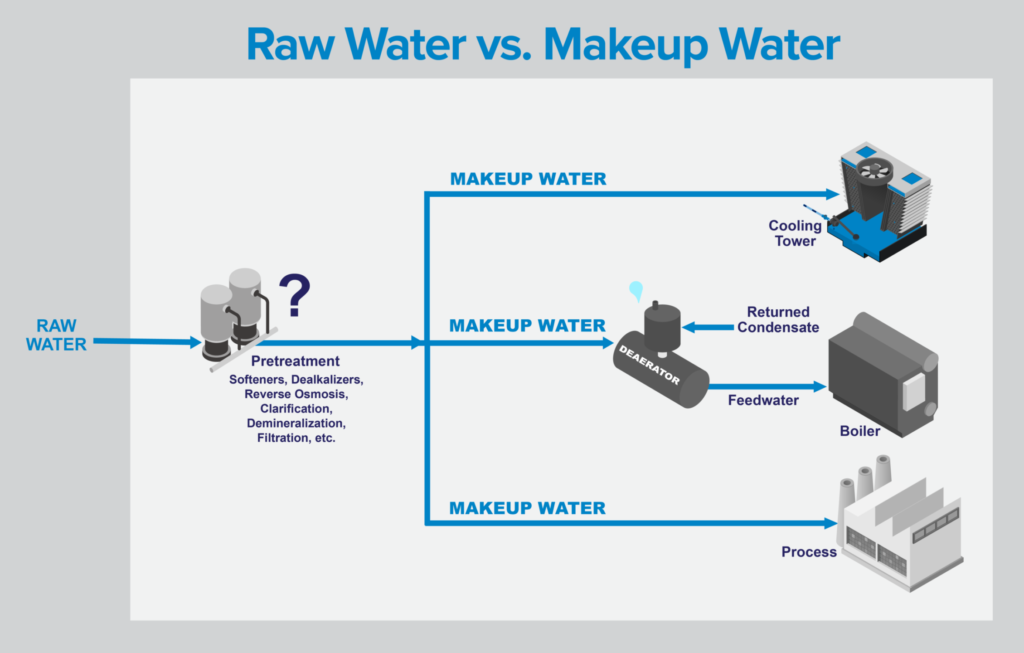
Cooling towers, boilers, closed loops, and various manufacturing processes require water to replace system losses. Raw water may not be of sufficient quality required without pretreatment, such as water softeners, dealkalizers, reverse osmosis, filtration, deaeration, and demineralization. Makeup water is defined as this raw water once it has been pretreated (if required).
In boiler systems, it is important to distinguish between makeup water and “feedwater.” While feedwater is the total volume of water pumped into the boiler, it is typically composed of a blend of makeup water and returned condensate (see Figure 1).
Why Raw Water Pretreatment is Necessary
Raw water quality can vary widely and may require additional treatment once it enters a facility, depending upon the end use. Potential contaminants can include suspended solids, dissolved minerals, hardness, oxygen, organics, and microorganisms. These contaminants can impact downstream water systems by:
- Forming insulative scale
- Causing corrosion
- Blocking flow
- Establishing biofilm
- Reducing heat-transfer efficiency
What are Common Pretreatment Steps
Depending upon the water quality required, there are multiple pretreatment options that can be applied individually or sequentially.
- Filtration: Removes suspended solids by passing water through a porous medium.
- Softening: Reduces calcium and magnesium hardness, usually by ion exchange.
- Dealkalization: Lowers bicarbonate/carbonate alkalinity to reduce corrosive carbonic acid.
- Reverse Osmosis: Uses pressure and a membrane to remove dissolved solids.
- Deaeration: Uses heat and steam to strip dissolved oxygen and carbon dioxide from boiler feedwater.
- Deionization: Removes dissolved ions from water through ion exchange to make high-purity water.
Common Misconceptions
Raw water and makeup water are often confused because both are “incoming” waters to a facility. However, they may have different characteristics, treatment needs, and roles, but misconceptions about them can lead to under‑treatment, over‑treatment, or system inefficiencies.
- Misconception: “Raw water” and “makeup water” are the same.
- Reality: They often are not the same because the end use (boiler, cooling tower, closed loop, process) require pretreatment of the raw water.
- Misconception: All incoming raw water sources are basically the same.
- Reality: Rivers, lakes, streams, reservoirs, wells, and municipal waters can have drastically different water qualities.
- Misconception: Municipal water doesn’t need pretreatment.
- Reality: Municipal water may contain contaminants that cause scale, corrosion, unwanted microbiological activity, etc. in downstream processes, which may require pretreatment.
- Misconception: Municipal/potable water meets all industrial water quality requirements.
- Reality: Industrial end-use water requirements may be stricter than municipal requirements.
- Misconception: Makeup water quality is the same for all systems.
- Reality: Boilers, cooling towers, closed loops, and process waters may all require different water qualities for optimal operation.
- Misconception: Raw water is always low quality and needs heavy treatment, while makeup water is always clean.
- Reality: Both can vary widely depending upon the origin and pretreatment steps taken. Surface water may be lower in hardness than well water. Well water can have lower suspended solids than surface waters.
- Misconception: Raw water pretreatment technology alone solves all downstream water issues.
- Reality: Solving water-related issues, such as scale deposits, corrosion, biofouling, water inefficiencies, etc., is a balance between factors such as equipment, chemistry, costs, labor, footprint, and infrastructure. Downstream chemistry can perform in conjunction with upstream pretreatment to achieve end goals. Also, other contaminants can enter the water system AFTER pretreatment steps.
Final Thoughts
Conclusion
Understanding the distinction between raw water and makeup water is essential for maintaining efficient, reliable industrial water systems. Raw water enters the facility with variable quality, while makeup water is the portion that has been conditioned to meet the specific needs of boilers, cooling towers, closed loops, and process systems. Recognizing how these waters differ and why pretreatment matters help prevent scale, corrosion, fouling, and unnecessary operating costs. When facilities pair the right pretreatment steps to the right end uses, they protect equipment, improve performance, and ensure long‑term system stability. Contact us today for any questions related to your water system requirements or any of these “Back to Basics” topics.