Defined as the ability of a water solution to conduct an electrical current, conductivity is a quick and easy test method. It is used every day in industrial water treatment to control blowdown rates in cooling towers and boilers, measure pretreatment performance, check condensate quality, troubleshoot for process contamination, and numerous other practical uses.
Impact of Dissolved Solids
The ability of a water solution to conduct an electrical current is determined by the concentration of ionized dissolved solids (cations and anions). The greater the concentration of dissolved solids, the greater the conductivity. Some ions contribute to conductivity more than others, as shown in the table below.
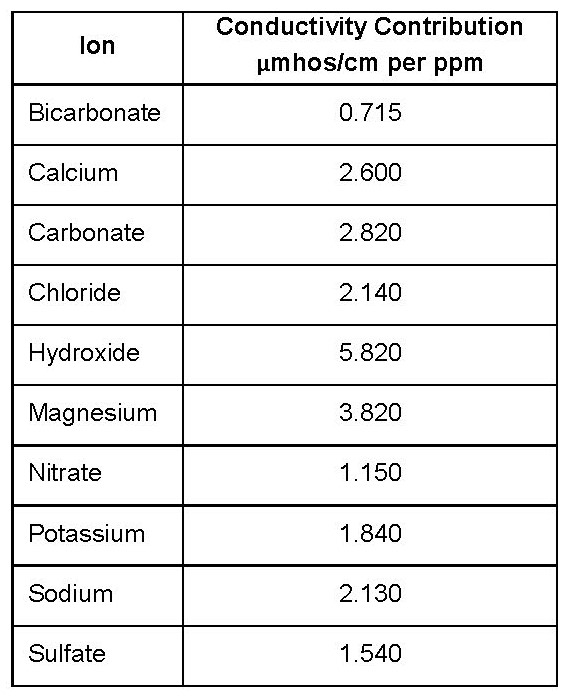
After reviewing this table, keep in mind that conductivity measurements are NOT specific to any particular dissolved impurity (e.g., calcium, magnesium, phosphate, bicarbonate). Multiple combinations of impurities could result in the SAME conductivity. It is possible for higher conductivity waters to cause fewer problems than lower conductivity waters, depending on the impurities that are present.
Sometimes, the conductivity of a water solution will be referred to as total dissolved solids (TDS). Technically, the two are NOT the same. As mentioned before, conductivity measures the ability of water to conduct electricity. TDS, on the other hand, is the concentration of dissolved solids in a water solution, which requires evaporating a volume of water to dryness and weighing the remaining solids. If the water quality is consistent, however, conductivity can be used to provide a practical way to monitor the TDS if the relationship between the two is confirmed regularly. As a rule of thumb, the actual TDS is typically 65-70% of the measured conductivity, but as noted, this can vary depending upon the ions in the water. Refer to our infographic, Conductivity vs. Total Dissolved Solids (TDS), for more information.
Impact of Temperature
Heat not only impacts the temperature of water but the conductivity as well. The higher the temperature, the more conductive water can be. In fresh water, an 18°F (10°C) increase in temperature can cause the conductivity to be 2% higher. As a result, most conductivity measurements are referenced to 77°F (25°C) and automatically compensated within the electronics of meter itself.
Do not use conductivity meters with samples hotter than specified by the manufacturer, which is commonly <160°F (71°C). Otherwise, the results will be inaccurate, and the automatic temperature compensation may be damaged. Allow meters with automatic temperature compensation sufficient time to stabilize for both warmer and cooler waters.
Impact of Scale and Precipitation
When dissolved ions become solid matter due to precipitation reactions (i.e., scale formation), the conductivity may fall because the ions are no longer in solution to contribute to the conductivity. This can be important in high-stress or poorly controlled water systems when scale is forming and the measured conductivity is not a true reflection of system performance.
Impact of Organic Substances
As previously shown, not all dissolved solids conduct electricity equally. Organic substances, such as sugar and oil, contribute very little to conductivity, if at all, because they do not ionize in water.
Units of Measure
The units of measure used for conductivity micromhos/cm (µmhos/cm) and microsiemens/cm (µS/cm). These two ways of expressing conductivity are equivalent to each other, which means 1 µmhos/cm equals 1 µS/cm.
Conductivity levels in excess of 1,000 are commonly expressed as mmhos/cm or mS/cm, where “m” stands for “milli.” For example, 1 mmhos/cm = 1,000 µmhos/cm.
Measuring Conductivity
Accurate conductivity measurement is important for a successful water treatment program. Each conductivity meter or probe comes with use and care instructions. Be sure to read these instructions prior to use. Refer to our Technical Bulletin, How to Accurately Measure Conductivity, for more information.
Measuring Conductivity in Boilers
Water samples containing high levels of hydroxide (OH-), such as boiler water, will exhibit unusually high conductivity. This is because hydroxide ions contribute significantly to conductivity (1 ppm = 5.820 µmhos/cm), which is much higher than other naturally occurring dissolved minerals, as shown in the previous table. Since the hydroxide ion is just a natural dissociation product of water, it is not considered a true dissolved solid (e.g., sodium, calcium, carbonate).
Boiler water samples are typically neutralized to remove the hydroxide ion’s contribution to conductivity if they are to be used for blowdown control purposes. Neutralization commonly involves adding Phenolphthalein Indicator to a measured quantity (50 mL) of boiler water sample, followed by titrating with a Gallic Acid solution until the test sample turns from pink to clear.
Boiler Condensate Conductivity
Condensate is basically distilled water with a very low dissolved solids content and theoretically should have a very low conductivity. Because of this, its conductivity is often used to infer steam purity, which is a measure of the concentration of substances other than water in the steam. Steam purity requirements vary from plant to plant. Some chemicals are desirable to have in the steam, including neutralizing amines and oxygen scavengers. However, most impurities are undesirable, including silica, copper, sodium, and particulate metal oxides. Steam purity comprises both volatile substances and dissolved substances carried over by water droplets entrained in the steam. The use of conductivity is an established method to monitor for contamination and carryover. When monitoring conductivity, consider the following important points:
- High conductivity coupled with high pH may be an indication of carryover.
- It is important to identify possible condensate contaminants for a particular plant and determine whether these contaminants will impart conductivity. Establish what level of conductivity is considered a problem. For systems prone to hardness contamination, correlate the conductivity level with hardness.
- The reaction between neutralizing amines and carbon dioxide imparts some conductivity to the condensate that is not related to carryover or contamination. In most situations, the contribution is minimal and the condensate conductivity will be in the 10 - 50 μmhos/cm range (typically less than 25 μmhos/cm).
- In some situations, the reaction between neutralizing amines and carbon dioxide can impart considerable conductivity to condensate. This is a fairly common phenomenon in neutralizing amine treated boilers using high alkalinity makeup water and occurs where large amounts of carbon dioxide (CO2 ) gas accumulate in the condensate. It occurs because the addition of neutralizing amine converts carbonic acid into bicarbonate and carbonate ions. Carbonic acid doesn’t contribute to conductivity while the bicarbonate and carbonate ions do.
Low Conductivity Waters
Low conductivity water samples can be impacted by small amounts of process contamination, carbon dioxide absorption, degassing, water treatment chemical dosing, etc. This may be seen when the makeup water conductivity is <100 µmhos/cm and may be severe when it is <50 µmhos/cm.
Conductivity vs. Cycles of Concentration
The cycles of concentration measure the degree to which the dissolved-solid impurities in a makeup water are concentrated in the system water, such as a boiler or cooling tower. Check out our Understanding Cycles of Concentration infographic and Understanding Cycles of Concentration blog to gain a further understanding.
Conductivity can typically be a good indicator of cycles EXCEPT where:
- The makeup conductivity is low (<100 µmhos). If the makeup conductivity is very low, even low levels of chemicals, dissolved gases, or other impurities can impact the tower water conductivity and the calculated cycles. The problem can be severe where the makeup conductivity is < 50 µmhos.
- There is a significant likelihood of calcium carbonate scale forming if something goes wrong (e.g., high calcium and alkalinity levels or inadequate scale inhibitor feed). The formation of scale can cause the conductivity of tower water to decrease enough to impact the cycles calculation.
- There are large amounts of sulfuric acid being used for pH control, especially where deposits are being re-dissolved. These factors can cause the conductivity of the tower water to be higher than would be expected based on the true cycles.
- There are large amounts of bleach being used for microbiological control, especially where the makeup conductivity is also low. This can cause the conductivity of the tower water to be much higher than would be expected based on the true cycles.
Conclusions
Conductivity is a quick and easy test to conduct that can tell a lot about the performance of an industrial water system. It is important to understand what conductivity is, how it’s measured, what can impact it, and how it is used. For more information about conductivity and your water operations, please contact your local Solenis representative.