Cooling towers are critical components in many industrial and commercial systems, providing efficient heat rejection to keep processes and comfort cooling running smoothly. In multi-cell cooling towers, equalizer lines play an essential role in maintaining balance between the basins of individual tower cells. Properly designed, installed, and maintained equalizers help ensure even water distribution, consistent system performance, and protection against costly mechanical issues.
What Are Equalizers?
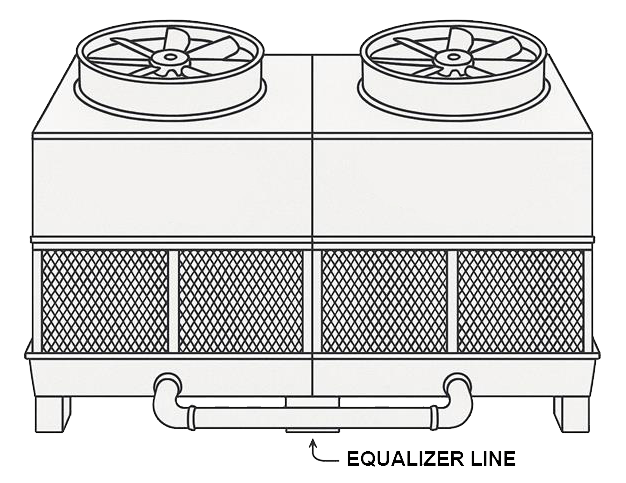
Equalizers are large diameter pipes that hydraulically connect the cold-water basins of adjacent cooling tower cells that share a common return header. Their purpose is to allow water to flow freely between basins so that all cells maintain similar water levels.
Without equalizers, one basin might overflow while another runs dry, leading to pump cavitation, air entrainment, pump air locking, and uneven system operation. Think of equalizers as the “balancing act” that keeps everything steady so that pumps receive adequate suction head and tower performance remains reliable.
Equalizers may be equipped with valves to allow for isolation of a cell while the rest of the cooling tower system remains functional for winter operation, maintenance, and inspection.
Why Proper Balancing Matters
Even with identical piping, flow to each cooling tower cell will differ due to imbalances caused by debris caught in nozzles, valve adjustments, etc. Manually balancing flow can be a time-consuming process for dynamic systems like cooling towers.
When equalizers do not function properly or do not exist, water level imbalances can create several operational challenges:
- Pump Issues: Low basin levels in one cell can starve a pump for water, causing cavitation and equipment damage.
- Overflow and Water Loss: Excess water in another basin may overflow into drains.
- Increased Stress on Equipment: Imbalanced operation can accelerate wear on pumps and tower components.
In short, poorly balanced basins can increase both operating costs and maintenance requirements.
How do Equalizers Impact Industrial Water Treatment?
Equalizers are typically low-flow environments and can collect debris and even become restricted over time. This may be especially true of equalizers coming off the bottom of cooling tower basins rather than the side.
Without proper flow, the water in the equalizers cannot receive proper corrosion inhibitor nor biocide treatment. This “dead leg” condition can cause problems, including corrosion, unwanted microbiological activity, and even become a persistent source of pathogens such as Legionella.
Equalizers are important because imbalanced operation can lead to overflow conditions in some basins, which wastes both water and treatment chemicals.
Best Practices for Managing Equalizers
To keep cooling tower basins properly balanced and equalizers problem free, facilities should incorporate the following practices:
- Routine Inspections – Regularly check equalizer lines for leaks, obstructions, or valve issues.
- Equalizer Cleaning – Clean equalizer lines regularly. Providing removable flanges at the ends of the piping or installing drain lines for online flushing may help.
- Basin Cleaning – Keep basins free of debris that could enter and clog equalizer connections.
- Water Treatment Programs – Effective scale, corrosion, and microbiological control can help reduce buildup inside equalizer piping.
- Flow Verification – Monitor water levels during operation to confirm equalizer performance, especially after system changes.
Balancing Act
Equalizers may not be the most visible part of a cooling tower, but their role in balancing basin water levels and impact upon water quality is vital to safe, efficient, and reliable operation. Facilities can help avoid costly issues by paying attention to equalizer design, maintenance, and performance. In the end, keeping equalizers in balance helps keep the entire cooling system in balance.
Contact us today for questions about and assistance with your cooling tower water systems.