Function
A deaerator preheats boiler feedwater and removes dissolved gases, especially oxygen and carbon dioxide. These gases are undesirable because they cause corrosion and increase treatment chemical requirements.
Operation
Deaerators operate based on the reduced solubility of dissolved gases as temperature increases. For example, the solubility of oxygen decreases from about five ppm at 150ºF to about two ppm at 190ºF. Virtually all the free carbon dioxide gas is removed by increasing the temperature to greater than 170ºF.
Types of Deaerators
Deaerating equipment is classified as either a deaerator or a deaerating heater. The distinction is based on performance ratings. Deaerators are capable of removing dissolved oxygen (DO) to 0.007 ppm (7 ppb) or less. Deaerating heaters are designed to reduce DO to below 0.04 ppm (40 ppb), which is less efficient than a true deaerator.
Design and Configuration
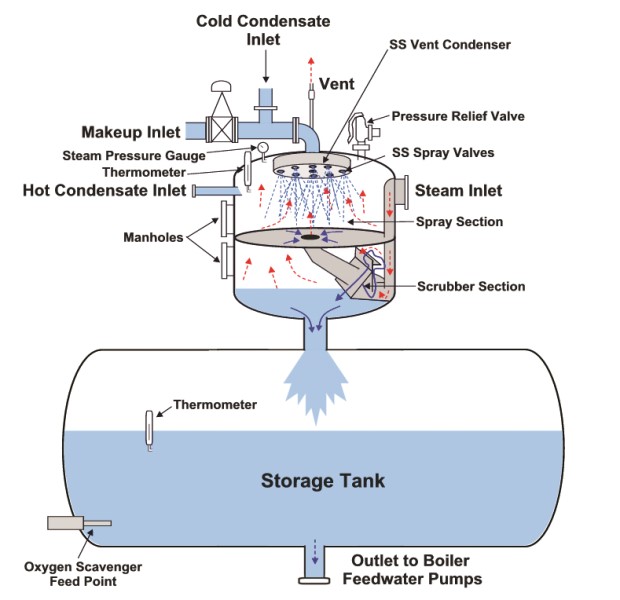
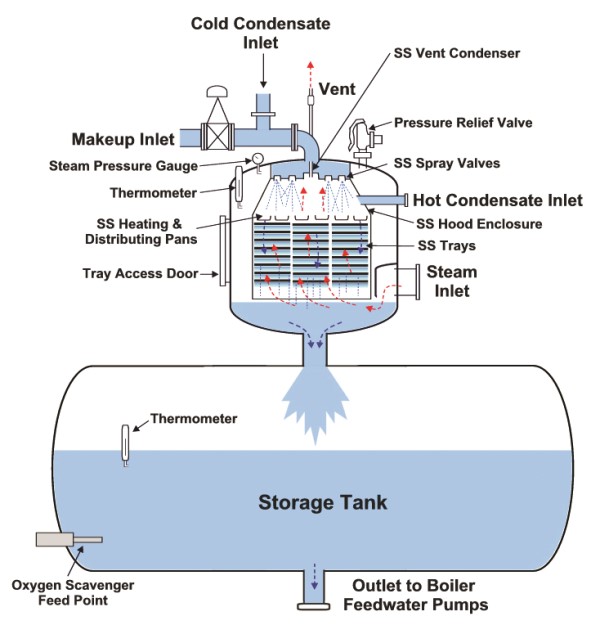
There are three common mechanical designs: spray-scrubber, spray-tray, and atomizing.
- Spray-scrubber - water is sprayed into a steam atmosphere then falls into a baffled scrubber section, where it is scrubbed and heated
- Spray-tray (or tray) - water is sprayed into a steam atmosphere then cascades onto a series of trays, where additional steam/water contact is made and heated
- Atomizing - water is sprayed into a steam atmosphere created by atomizing jets, then is heated and falls to the storage section
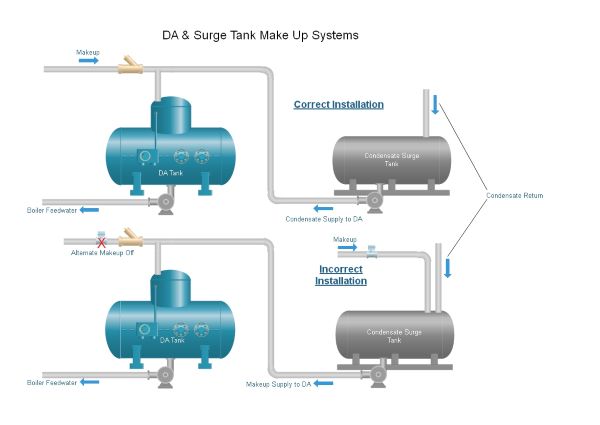
The storage and deaerating sections can be separate or combined in a single tank. Single tank designs typically use a separate storage compartment to mix makeup and condensate before pumping to the deaerator. If the surge tank is not made of stainless steel, it may be necessary to feed oxygen scavenger to this section to effectively control corrosion. This practice can increase oxygen scavenger usage and costs significantly. The preferred configuration is to have cold makeup and hot condensate enter the deaerating section via separate lines, mixing in the deaerating chamber. Sometimes, makeup and condensate are mixed prior to the deaerator, with the combined feedwater being fed to the deaerating section. The release of oxygen when the hot condensate mixes with the cold makeup water can cause pitting and rapid failure of the downstream piping unless stainless steel is used.
Some plants have a condensate surge tank-deaerator combination where cold makeup water is added to a surge tank rather than the deaerator. The dissolved oxygen released from the cold makeup water when it mixes with the warmer condensate (140-180⁰F) can cause severe corrosion in the surge tank and transfer lines. Ideally, the makeup water should be added directly to the deaerator. Where this is not possible, the oxygen scavenger feed point can be moved to the surge tank to reduce the potential for oxygen corrosion. However, this will significantly increase oxygen scavenger feed requirements.