Water softeners are ion exchange systems designed to remove scale-forming calcium and magnesium ions prior to boiler, cooling, and reverse osmosis systems. The amount of hardness a softener can remove between regenerations is known as the softener capacity and can be expressed either in grains or in gallons. Capacity is important when sizing, configuring, or troubleshooting a softener.
To calculate softener capacity, you must know
- Raw water hardness in ppm
- Resin volume in cubic feet (ft3)
- Salt dosage in pounds(lbs)/ft3 of resin
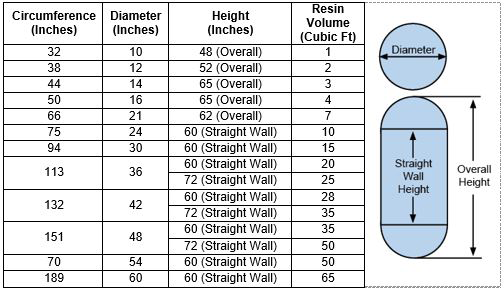
If the resin volume is unknown, Table One can be used to cross-reference the tank circumference and height to the resin volume. The salt dosage during regeneration determines the resin exchange capacity. Typically, a salt dosage of 15 lbs/ft3 resin is used to provide an exchange capacity of 30,000 grains/ft3 resin. Lower salt dosages reduce capacity, but allow for more economical salt usage, which is the basis for salt saver dosage. See Softener Regeneration with Salt Saver Dosages (TB4-006).
Each calculation is followed by an example, using this information: The water contains 118 ppm of total hardness and the softener has 6 ft3 of resin that is regenerated using 15 lbs of salt per ft3.
The softener capacity is calculated in three simple steps:
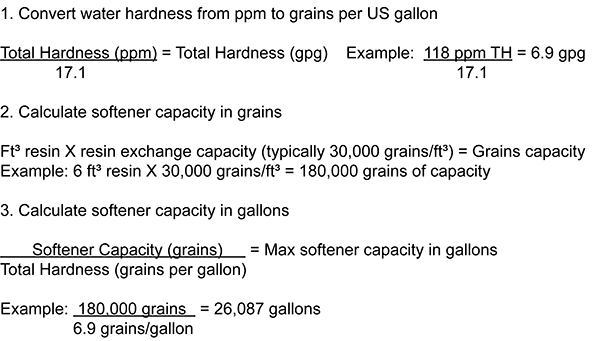
A 10% Safety Factor is applied to prevent hardness from breaking through.
Example: 26,087 gallons X 0.90 = 23,478 gallons of capacity with 10% safety factor