The term “cycles of concentration” is the basis for one of the most important concepts in industrial water treatment. The cycles of concentration measure the degree to which the solid impurities in the makeup water are concentrated in the recirculating water of an evaporative system. The higher this ratio, the more the impurities in the makeup water are being concentrated in the system water. This directly impacts the system’s water usage and treatment requirements along with the potential for waterside problems to occur, such as scale deposits and corrosion.
Calculating Cycles of Concentration
Mathematically, the cycles of concentration (or just “cycles”) is equal to the amount of makeup water added to an evaporative system divided by the amount of liquid water removed from the system (blowdown):

For example, if a cooling tower has a makeup volume of 300,000 gallons and blowdown of 50,000 gallons in a month, it operated at an average of 6 cycles. This calculation will provide an accurate estimate of the cycles if ALL blowdown is metered. However, if a significant amount of liquid water is removed from the system through overflow, leaks, or drift, which are NOT recorded by the blowdown water meter, the estimate will not be accurate. These are all forms of unintentional blowdown. Metered makeup and blowdown may be the only practical method of determining the true cycles if the makeup water quality changes drastically and frequently.
In practice, we typically estimate the cycles based upon the relative impurity levels in the system and makeup water using one of the following equations:

For example, if the system water conductivity is 1,000 µmhos and the makeup water conductivity is 200 µmhos, the system is assumed to be at 1,000/200 = 5 cycles.
How to Monitor Cycles in Evaporative Cooling Systems
Picking the best test parameter to use to monitor the cycles in an evaporative cooling system is not always straightforward. Sometimes conductivity provides the best indicator, while at other times the relative chloride or silica levels are more appropriate.
In theory, it should not matter which of the above test parameters is used because at 5 cycles the level of all three in the system water should be 5 times the makeup level. In reality, this may not be the case.
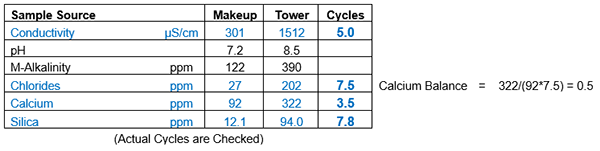
In the water analysis below, all three of the key test parameters used to monitor cycles (in blue) indicate that about 5 cycles are being maintained. The differences are considered minor in the scheme of things.
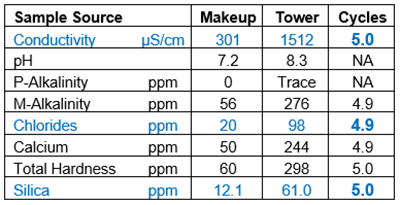
You won’t always have a complete water analysis to look at to see how well all the test parameters agree and when you do you will not likely find such good agreement. You must determine which test parameter provides the most accurate gauge of cycles and use that one for monitoring the cycles.
Following are some general guidelines that will help you determine the best indicator of cycles in an evaporative cooling water system.
Conductivity - The relative conductivity levels are usually a good indicator of the cycles EXCEPT where:
- The makeup conductivity is low (<100 µmhos). If the makeup conductivity is very low, even low levels of chemicals, dissolved gases, or other impurities can impact the tower water conductivity and the calculated cycles. The problem can be severe where the makeup conductivity is < 50 µmhos.
- There is a significant likelihood of calcium carbonate scale forming if something goes wrong (e.g., high calcium and alkalinity levels or inadequate scale inhibitor feed). The formation of scale can cause the conductivity of tower water to decrease enough to impact the cycles calculation. This seems to be a more severe problem where the alkalinity level is higher than the calcium hardness and the makeup conductivity is relatively low (< 300 µmhos).
- There are large amounts of sulfuric acid being used for pH control, especially where deposits are being re-dissolved. These factors can cause the conductivity of the tower water to be higher than would be expected based on the true cycles.
- There are large amounts of bleach being used for microbiological control, especially where the makeup conductivity is also low. This can cause the conductivity of the tower water to be much higher than would be expected based on the true cycles.
Chlorides - The relative chloride levels can be a good indicator of the cycles EXCEPT where:
- The makeup chloride level is low (<10 ppm). If the makeup chloride level is low, even minor testing variances can cause major differences in the calculated cycles. The less-than-distinct nature of the chloride test endpoint (i.e., silver nitrate method) can make it difficult to measure low levels of makeup chloride accurately.
- Oxidizing biocides are used. The use of chlorine and bromine compounds can significantly increase the measured chloride level. The interference is especially significant if the makeup chloride level is low. The interference may not be of consequence if the makeup chloride level is high.
Silica - The relative silica levels can be a good indicator EXCEPT where:
- The makeup silica level is low (< 4.0 ppm). The detection limit for the commonly used High Range silica test is ±1.0 ppm. Inherent testing inaccuracies at low silica levels can result in wide variations in the calculated cycles.
- The makeup silica level is high and there is concern about silica precipitation. The formation of silica scale is usually only a concern if tower water silica levels exceed 150 ppm and/or large amounts of magnesium are also present.
Calculating the Calcium Balance
A key objective of any cooling tower treatment program is the prevention of calcium carbonate scale, which forms when calcium hardness and carbonate alkalinity combine due to over-concentration. This objective is typically accomplished by limiting the concentration of calcium and alkalinity in the tower through cycle control (blowdown) and the addition of chemical scale inhibitors.

Calcium can also combine with other anions such as phosphate (PO4)-3, sulfate (SO4)-2, or silicate (SiO4)-4 to form scale. One way to gauge whether a calcium-based scale is forming (precipitating) is to calculate the “calcium balance.” This involves comparing the calcium cycles with your best estimate of the actual cycles of concentration.

- If calcium is being kept in solution, the calcium balance will be approximately equal to 1.0.
- If calcium is precipitating, the calcium cycles will be significantly less than 1.0.
- If calcium scale is being re-dissolved, the calcium cycles will be greater than 1.0. This is a good thing if you are trying to “clean up” calcium scale.
The following water analyses illustrate how the concept of a calcium balance can be used to gauge whether scale formation is occurring in a cooling tower system. Note the comparison between the actual cycles and calcium cycles on the following three tables.
Example 1:
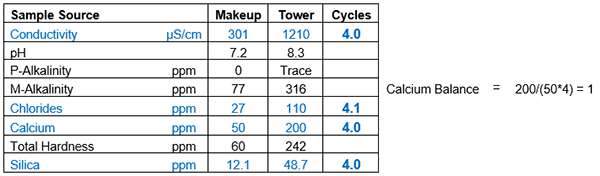
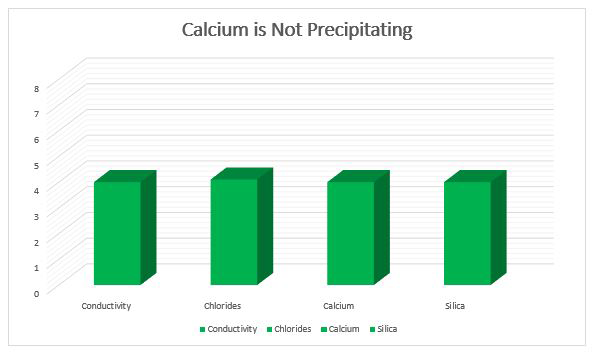
Example 2:
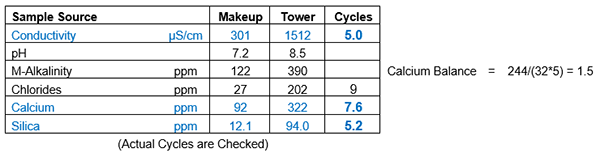
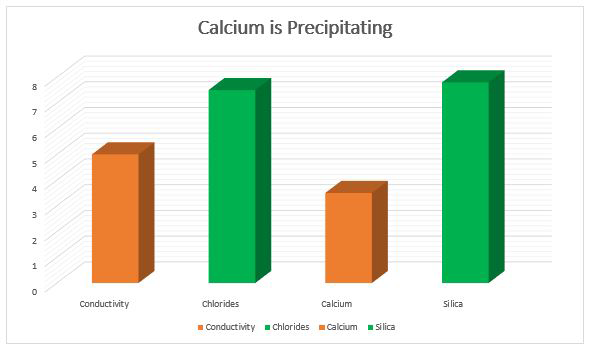
Example 3:
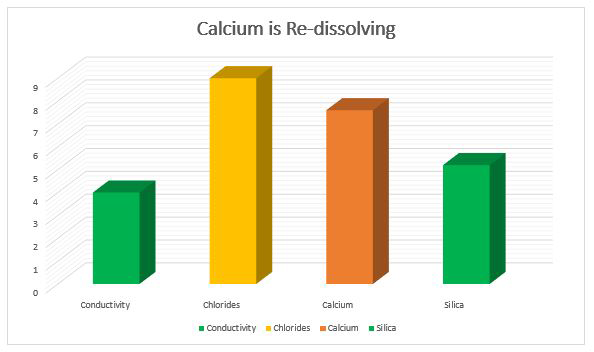
Conclusion
Understanding how to use the above guidelines for determining the cycles is critical when treating systems that use scale-forming makeup water. Solenis has the expertise to help you determine both your actual and optimum cycles within your cooling water system.
Related Resources
View our video: Understanding Cycles of Concentration
View our infographic: Understanding Cycles of Concentration