Regulations and Compliance
Hospitals use steam boilers to meet a variety of needs including domestic hot water, space heating, food preparation, sterilization, and humidification. The use of water treatment compounds called “neutralizing amines” can be a source of confusion, especially where plant steam is used for humidification and sterilization. Recently updated standards provide clear guidance on neutralizing amine use in hospital steam boiler systems.
What are Neutralizing Amines?
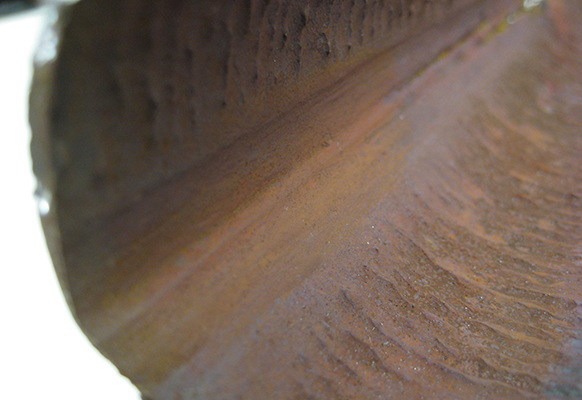
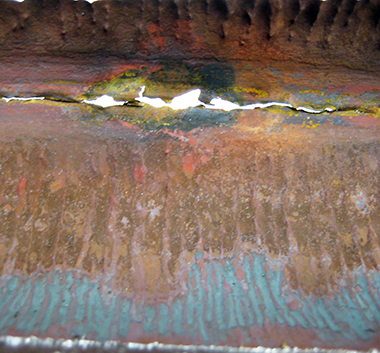
Without proper treatment, steam condensate will become acidic and cause severe corrosion damage to the condensate return system. Neutralizing amines are volatile compounds that control corrosion by neutralizing the corrosive carbonic acid that forms in the condensate due to the thermal decomposition of the natural alkalinity in the boiler makeup water. Neutralizing amines are essential for effective corrosion control but must be properly applied and monitored to meet regulatory guidelines.
Key Standards and Regulations
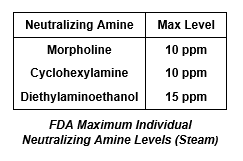
ASHRAE1/ASHE2 Standard 170-2013 (Ventilation of Health Care Facilities) specifies that the additives used in steam systems serving humidifiers in healthcare facilities must comply with U.S. FDA regulations (21 CFR 173.310). These FDA regulations define the boiler water additives (including neutralizing amines) that are approved for use in boilers where the steam comes in direct contact with food.
AAMI3 ST79:2017 (Comprehensive Guide to Steam Sterilization and Sterility Assurance in Health Care Facilities) provides recommended practices for steam quality, steam purity, and monitoring for effective steam sterilization. AAMI ST79 also dictates that only FDA approved boiler additives be used and provides recommendations for boiler chemical application and monitoring.
Where condensate system corrosion cannot be controlled without exceeding FDA regulated maximum amine levels, a dealkalizer or reverse osmosis system may be necessary to reduce the makeup water alkalinity.
Add Neutralizing Amines to Feedwater
AAMI ST79 requires that boiler additives including amines always be injected into the boiler feedwater, and specifically states that amines should NOT be injected into the steam header or steam lines.
Adding the amine product to the feedwater tank or deaerator helps ensure good dilution in a large volume of water prior to steam generation. When the feedwater eventually turns to steam, the amine concentration will be much more consistent regardless of the steaming rate, condensate return, which boiler is online, where the steam flows, etc. Since amine dosage requirements are a direct function of how much natural alkalinity enters the boiler system via the makeup water, it is recommended they be fed in direct proportion to boiler makeup water usage.
Any facility that requires FDA/USDA approval should feed amines to the feedwater to ensure consistent distribution. Other industries that use steam for humidification such as laboratories, textiles, semiconductors, electronics, etc. would fall under the same guidelines. Although adding amine to the feedwater instead of the steam will result in some loss due to venting and blowdown, the amount is usually minor.
Monitoring Neutralizing Amine Levels
To confirm compliance with FDA/USDA regulations, a condensed steam sample should be periodically taken for laboratory analysis to determine neutralizing amine levels. The steps include:
- Collect steam sample directly from the steam header or a steam line before any steam traps or vented receivers. Condensate samples will not provide representative test results.
- Use a sample cooler or cooling coil to completely condense the steam sample (no flashing). Flush sample to drain for 15 minutes prior to collection.
- Fill a clean plastic sample bottle to the top, allowing a slight overflow. Cap immediately, taking care to assure there is no head space of air above the liquid.
- Label sample bottle identifying the specific amines to be tested. Promptly ship to testing laboratory.
Conclusion
Solenis has the capabilities, experience, and expertise to help you protect your building water systems and stay in compliance with key regulations. For additional information on this topic, check out our Technical Bulletin TB1-030 “Neutralizing Amine Use in Hospital Steam Boilers.”
Solenis is a global leader in custom-designed programs for boiler, cooling, and process water systems. Our success has been built upon our Total System Approach, providing solutions for water treatment problems and improving water system efficiencies.