Steam quality and steam purity are topics that often get confused with each other. Distinguishing the difference between the two will help you understand the unique impacts they have on a steam system.
Steam Quality
Steam quality is a measure of moisture in the steam expressed as the percentage of steam vapor in the steam/water mixture. For example, 99% steam quality contains 1% liquid water. Once steam quality is known, the percent moisture can be calculated using Equation 1.
Equation 1: % Moisture = 100 - % Quality
Understanding steam quality requires understanding vapor-liquid equilibrium in water. As Figure 1 illustrates, when heat is added to subcooled liquid water, it proceeds to the saturated liquid curve and becomes a saturated liquid (moving from incoming city water to point A). At the saturation point (Point A in the figure below), any heat added to the water will form a vapor and the temperature will remain the same because all additional enthalpy (heat energy) being added to the system is being used to change the phase of the water from liquid to vapor. A saturated fluid in the liquid-vapor region at a given pressure always has the same temperature. This explains why the temperature in the waterside of a boiler or a deaerator can be predicted at a given pressure. As heat continues to be added to the water, more steam forms, but the solution remains in equilibrium (moving from points A → B in the figure below) and the temperature of the fluid remains the same. The region between points A and B is where most steam exists in traditional boiler applications with the preference being closer to B. At point B, the water reaches the vapor saturation point for that pressure. Adding heat to water above the saturation point superheats the steam.
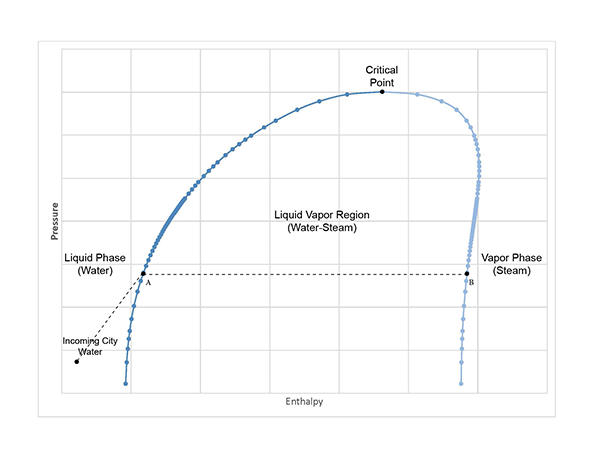
Steam quality is the percentage of steam present in a mixture of steam and moisture (between points A and B). When boilers produce steam, unless it’s superheated, it begins to lose quality (condense back to liquid by losing heat) as soon as it leaves the boiler. Wet steam is less efficient and potentially damaging to system equipment. Poor steam quality is typically the result of one of the following:
- Malfunctioning steam traps
- Lack of insulation on steam lines
- Boiler water carryover
In an autoclave or sterilizer application, manufacturers typically require steam quality within a band to ensure the steam isn’t too hot or too wet. Steam that is too wet doesn’t have sufficient energy to sterilize equipment, and steam that is superheated may be too hot. Steam quality is extremely important in applications where steam is turning a turbine because water condensing on the blades could result in turbine blade erosion and the turbine losing balance. Measuring steam quality requires a calorimeter (Separating Calorimeter or Throttling Calorimeter) and accurate readings of steam temperature, pressure, and steaming rate. It can be difficult to measure.
Steam Purity
Steam purity is a measure of the amount of solids (entrained or dissolved) present in the steam and is reported as ppm or ppb. Poor steam purity is typically the result of one of the following:
- Boiler water carryover
- Accelerated corrosion rates in steam lines
- Process contamination
Steam purity is much more of a concern in Industrial boilers without superheaters (Max 1 ppm TDS), Superheated Industrial Boilers (Max 20 ppb Sodium & Max 20 ppb Silica), and Healthcare sterilizer applications. Steam Purity can also be much easier to measure.
Conclusion
One should consult equipment manufacturer manuals and guidelines for steam purity and quality requirements. A customized approach may be required to solve steam purity and/or quality issues. Solenis is a global leader in custom-designed programs for boiler, cooling, and process water systems.