Transferring heat into a process or rejecting excess heat from your facility is critical to keeping your facility up and running. Failure to transfer heat effectively to and from your equipment and processes may lead to increased operating costs, downtime, unscheduled maintenance, and reduced equipment life. Heat always flows from higher temperature to lower temperature in one of three ways: conduction, convection, and radiation.
Conduction
Conduction is one of the most common forms of heat transfer. Conduction is the transfer of heat through physical contact. An example of heat transfer through conduction is a metal handle on a heated pot. Over time, heat from the fire will migrate up through the metal handle and eventually become too hot to hold. Metals are usually good conductors of heat, but not every material is. Materials like glass, wood, and air are poor conductors of heat and are known as insulators. As a general rule of thumb, materials that conduct heat well, conduct electricity well too. The same concept applies to insulators.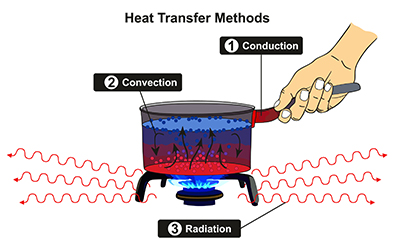
Convection
Convection is the transfer of heat within a liquid or gas fluid, due to mixing of hotter materials rising and cooler materials sinking. Convection happens when there is a difference in temperature between two parts of a liquid or gas. For example, as water is heated in a pot, the less dense hotter water rises to the top of the pot while the more dense cool water sinks to the bottom, setting up a natural circulation. A steam boiler functions in much the same way.
Radiation
Radiation is a method of heat transfer that does not rely upon any contact between the heat source and the heated object. For example, we feel heat from a heated pot and flame even though we are not touching them. Radiation is the least efficient method of heat transfer.
Why is this important?
Facility engineers must take into account all three forms of heat transfer: conduction through a heat exchanger metal, convection of heat through fluids such as water and air, and radiant heat from equipment and occupants. For example, the average occupant in an office setting may generate up to 400 BTU/hour of heat while doing general office work.
Boilers, cooling towers, and chillers are industry work horses for transferring heat from one location to another. They require expertise and management to control scale, deposits, corrosion, unwanted microbiological activity, water usage, and environmental impact. As a global leader in custom-designed water treatment programs, Solenis has the experience, knowledge, and technology to keep your facility running efficiently. To learn more, contact us today!