Microbiological problems in cooling water systems cost businesses billions of dollars each year due to high energy costs, production losses, unscheduled maintenance, and replacement of corroded parts. Poor microbiological control can also lead to unsafe operating conditions, such as contamination by the bacterium that causes Legionnaires’ disease. While this article focuses on biocide contact time, there are many factors to consider when choosing the correct biocide, including:
- Types of microorganisms present
- Water characteristics
- Biocide properties and limitations
- Environmental restrictions
- Product label restrictions
- Feed methods
- Holding time
- Biocide contact time
The biocide contact time and the holding time index (HTI) need to be considered when designing a biocide program. The contact time for a biocide is the minimum amount of time it must be in contact with the target microorganisms at an effective level to control growth. Biocides that kill quickly are said to have a short contact time, while biocides that require sustained contact to control microbiological growth are said to have a long contact time. Fast-acting biocides can have a contact time of as little as half an hour. Slow-acting biocides can have a contact time of over six hours.
The holding time index of a cooling water system also called the half-life or retention time, is a measure of how much time it takes for a chemical that is added to a system to be diluted to 50% of its original concentration due to blowdown. For example, if you add 100 ppm of biocide to a system, the HTI calculation will tell you how long it will take for the concentration to drop to 50 ppm. The HTI is a function of the system volume and the blowdown rate: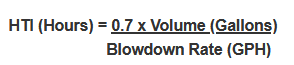
Cooling systems that contain a small volume of water relative to the blowdown rate have a short HTI, while systems that contain a lot of water relative to the blowdown rate have long HTI. As another example, the HTI for a 500-gallon evaporative condenser with a 225 GPH blowdown rate would only be 1.6 hours. If the same blowdown rate were associated with a 10,000-gallon cooling tower system, then the HTI would be 31 hours.
Systems with a short HTI, such as evaporative condensers or fluid coolers, should ideally be treated with biocides that act quickly. Otherwise, the majority of the biocide added will be lost to blowdown before it has an opportunity to do its job. Another option would be to use a high enough dosage of a slower-acting biocide to achieve the necessary concentration of biocide for the required amount of time. However, this can be quite expensive and care must be taken to not exceed the maximum dosage specified on the label. It is especially important to add non-oxidizing biocides quickly to low HTI systems.
Because cooling towers continually scrub impurities from the air as they operate, contaminants can build to very high levels in systems with a long HTI (> 48 hours). This of course makes microbiological control more difficult and may require higher biocide dosages. The HTI also needs to be considered when selecting scale and corrosion treatments because key inhibitor components can degrade or be consumed in systems with a long HTI. In systems with seasonal differences in blowdown, which includes virtually all HVAC systems, the HTI will vary seasonally as well.
For questions about biocide selection and the impact of contact time, contact Solenis today!