Industry uses water every day for heating, cooling, cleaning, product components, and more. This includes manufacturing, commercial, institutional, healthcare, food & beverage, hospitality, power generation, and other industrial-sized users. The unique properties of water along with its plentiful supply in many areas make it both an invaluable and irreplaceable resource. Industrial water treatment is the process of managing water used in industrial facilities through applying chemistry, equipment, and service. While oil lubricates the wheels of industry, water is its lifeblood.
Key Industrial Water Systems Requiring Treatment
Proper water treatment is not a one-size-fits-all approach and is tailored to protect specific systems. The most common systems include:
- Boilers: Produce steam for power, heating, and industrial processes. Treatment prevents scale and corrosion, ensuring safety and efficiency.
- Cooling Towers: Remove heat through evaporation. Treatment controls scale, corrosion, and microbiological growth, such as Legionella.
- Closed Loops: Recirculate water to heat or cool equipment. Treatment focuses on long-term corrosion inhibition and microbiological control.
- Process Water: Water used in manufacturing as as an ingredient, cleaning medium, or facility operation. Treatment ensures consistent, high-quality water that won't harm the final product.
- Wastewater: Water destined for discharge. Treatment removes regulated contaminants to meet environmental compliance standards.
Why is Industrial Water Treatment Necessary? The Core Challenges
Water introduces significant challenges that industrial water treatment programs are designed to solve:
- Scarcity: Reduced availability of water of sufficient quality.
- Corrosion: Damages metals, reduces equipment lifespan, causes leaks, and increases safety risks.
- Scale Deposits: Reduces heat transfer efficiency (which increases energy costs), plugs up piping and equipment, and may lead to under-deposit corrosion.
- Microbiological Growth: Can cause severe corrosion and insulating biofilms, plus negatively influence health risks.
- Health Risks: Waterborne pathogens (e.g., Legionella) may pose a risk to surrounding populations.
- Efficient Use: Water has value due to its initial cost plus any pretreatment expenses, heating/cooling energy, and chemicals added.
- Environmental Impact: Both extracting water and adding water back to the environment has an impact that must be properly managed.
How Does an Industrial Water Treatment Program Work?
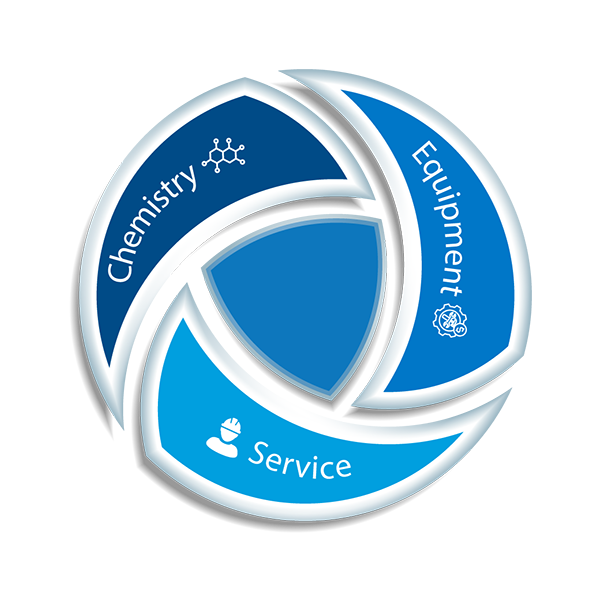
A comprehensive industrial water treatment program is a three-part solution that addresses these challenges holistically.
Water Treatment Chemicals
Specialized formulations, including scale inhibitors, corrosion inhibitors, and biocides, are precisely fed into systems to manage water chemistry.
Water Treatment Equipment
Supportive hardware is used for pretreatment and control, such as water softeners, reverse osmosis (RO) systems, and chemical feed pumps.
Expert Service and Support
The most critical component. Water treatment professionals provide ongoing testing, monitoring, and adjustment to optimize the program, supported by engineers and scientists.
The Sustainability Benefits of Industrial Water Treatment
Industrial water treatment was FOUNDED as a more sustainable alternative to using water only once, accepting energy-robbing scale as a cost of doing business, tolerating equipment-destroying corrosion, and dumping hazardous wastewater to the environment. Through advances in chemistry and equipment with the support of expert service, industrial water treatment minimizes the impact upon the environment by maximizing water and energy efficiencies, minimizing scale and corrosion, and optimizing wastewater treatment. The benefits are clear:
- Saves energy – Preventing just 1/32” of scale can improve heat transfer efficiency by up to 10%.
- Conserves water – Advanced treatment enables higher cycles of concentration in cooling towers and water reuse, significantly reducing freshwater withdrawal.
- Protects the environment – By minimizing water usage and, optimizing water treatment, treatment programs reduce a facility's environmental footprint.
- Extends equipment life – Preventing corrosion and scale adds years to the lifespan of boilers, chillers, and piping systems.
Conclusion
From powering data centers to manufacturing our food, industrial processes depend on water. Industrial water treatment is the unseen engine that makes this possible, ensuring reliability, efficiency, and sustainability.
Solenis has a long and successful history of providing world-class industrial water treatment solutions through our expertise in chemistry, equipment capabilities, and dedicated service. Contact Solenis today to develop a customized program that protects your assets and meets your operational goals.