Calculating Parts Per Million
The phrase “Part Per Million” is a term we use to describe very small amounts of something in a much larger amount of something else. Here are some examples of one part of something in a million parts:
1 inch in 16 miles is a part per million
So 16 miles has about 1,000,000 inches
PROOF: 16 miles x 5,280 ft/mile x 12 inches/ft = 1,013,760 inches
1 minute in 2 years is a part per million
So 2 years has about 1,000,000 minutes
PROOF: 2 years x 365 days/yr x 24 hrs/day x 60 minutes/hour = 1,051,200 minutes
1 car in bumper-to-bumper traffic from Cleveland to San Francisco is a part per million
So if the average car is 13 ft long and the distance from Cleveland to San Francisco is 2,464 miles
PROOF: 2,464 miles x 5,280 ft/mile = 13,009,920 ft
13 ft/car x 1,000,000 cars = 13,000,000 ft approximately the distance between Cleveland & San Francisco
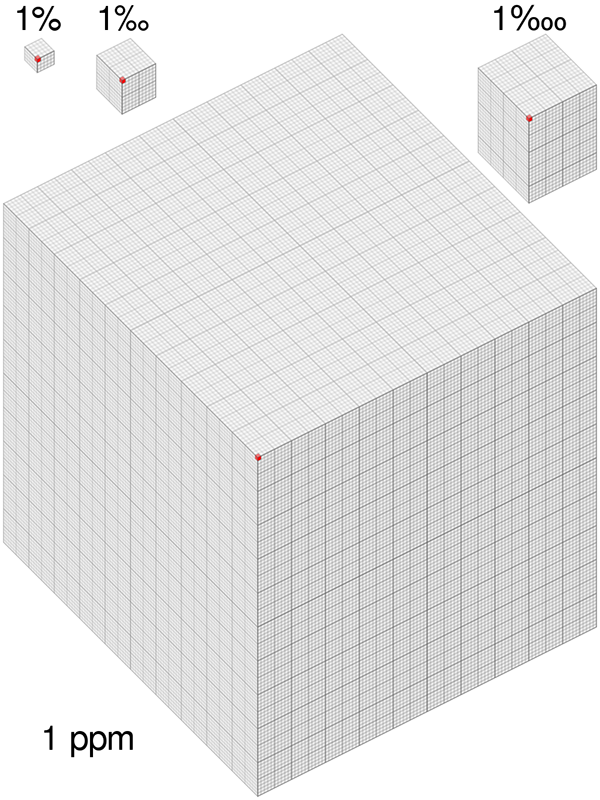
The bottom line is that a part per million (ppm) is a very small quantity of something in a very large amount of something else. Using the term “ppm” is easier than having to express concentrations as very small fractions or large numbers (e.g., 0.000016 or 1 car in 13,009,920 feet). A term used many times interchangeably with ppm is milligrams/Liter (mg/L). One liter of water weighs 1 million milligrams; so an mg/L equals 1 ppm.
1 mg/L = 1 ppm
Why is the PPM Measurement Important?
In water treatment, we use ppm to measure the amounts of minerals and gasses dissolved in water. We use water as a medium to transfer heat. As the water transfers heat, these dissolved impurities in ppm can cause problems in the equipment such as mineral scale and corrosion. Water, depending on its characteristics, can only dissolve so many parts per million of a mineral. Then, when we change the temperature and concentration of the water, these minerals may want to come out of solution. We use treatment chemicals measured and added in ppm to help prevent these problems.
How Do You Determine PPM?
PPM is either measured by running chemical tests or calculated. It can be determined by testing the water using titration, colorimetric, or ion-selective-electrode (ISE) methods. In US English units, ppm is calculated with the following equation:
ppm = 120,000 (lbs added)
Volume in gallons
Conclusion
There are many units of measure and acronyms used within water treatment. Knowing and understanding why they are important and what they mean can be key to a successful water treatment program. Water is essential to all of us, and life would be totally different without it. What’s in your water?